• Home
    • Testimonials
    • Photos
  • Blog
  • Courses
    • 2-Day Defensive Shotgun Course ($350.00)
    • Advanced Defensive Shooting Courses
    • AR-15 / Carbine Course
    • Concealed Carry Fundamentals(CCW)
    • Intro to Defensive Shooting / Home Defense
    • NRA Refuse To Be A Victim
    • Pistol Marksmanship Course
  • Schedule
  • Contact
  • About
    • Instructor Tim Milligan

T-M Firearms Training

~ Basic and Defensive Firearms Training.

T-M Firearms Training

Category Archives: Uncategorized

Goals?????

01 Monday Dec 2014

Posted by tmfirearmstrain in Uncategorized

≈ Leave a comment

Goals????

I suppose I should start by asking; What are your goals when you purchase a defensive firearm (handgun primarily)? You had to have something in mind when you undertook the responsibility of the purchase of a defensive weapon. So with that you must have a context for which you chose the firearms use, concealed carry, home defense, personal protection, maybe it’s a back-up for your primary when on duty or carry weapon for off duty, maybe all the above? I expect that anyone who bought a firearm for defensive purposes set some sort of goal. Short term, long term, or easily attained or hard to achieve goals to keep you training and advancing and making you better prepared for a life threatening situation. They say set goals that are attainable. When you reach those goals set new ones to better you in whatever you do. Keep moving the goal line further and further down the field.

So if you have never really thought about it here are some goals I set for myself. Goals you should also consider as a defensive firearms owner. I will spend the rest of my life trying to achieve them and helping others who choose to do so as well by teaching and training.

I want to achieve the highest level of marksmanship and precision shooting ability in order to maintain a hit rate of a minimum of 55% when shooting under stress in a critical incident in lighted or low light conditions. I set that hit rate to 55% minimum with the understanding and knowledge of what is going to happen to me both psychologically and physiologically when under stress. Even with a 95-100% hit rate in practice, training, and competition I know my hit rate will fall drastically in a life threatening situation so I must maintain at the highest level of marksmanship. This level of marksmanship is reached by mastering the fundamentals of shooting; trigger control, sight alignment and sight picture, breath control, trigger reset, and follow through to a point where you no longer have to think about the steps when shooting. There must be a smooth consistent flow from start to finish of the process for each individual shot and into any subsequent shots that must be fired. Shooting as fast as you can and still maintain an acceptable level of accuracy to meet the needs of the situation. How will I ever know if I have attained that goal? I hope to never have to find out. In practice and training I push to get 100% of my hits in a precision shot (smallest target) in defensive shooting this is the ocular cavity of the head. Also 100% of my hits in a 8-10 inch circle of the high center chest area of the body. I want to do this shooting strong hand, support hand, and two handed. Always pushing the limits to get better.

I also want to achieve a high level of efficiency in my gun handling skills. Skills like loading, reloading, clearing stoppages and malfunctions, the draw and presentation. This is accomplished by forming muscle memories through perfect practice, perfect repetition, and high level training and learning the most efficient techniques to accomplish each task. Here again we are performing skills without thinking about the steps involved. A smooth consistent flow with speed to get on target when time may be of the essence. Bringing all of the skills to a point of response where we are not thinking about them but are doing them as a part of our response to a threat regardless of any position we might find ourselves in.

Another goal is to gain a high level of control over myself. Control psychologically and physiologically. Keeping control during the chemical dump that happens during a critical incident and physical affects that come with it. Using natural flowing chemicals to enhance performance. Keeping emotions in check. Calm, Cool, and Collected. This will help me to perform those physical skills we noted earlier at a higher level of efficiency. This done during training and stress inoculation through scenario training. The best way to master this is through actual experience in real life fights but not all of us will have that experience. That is why we rely on those who have and training. Optimal situational awareness is a part of this area as well. Always aware of your surroundings.

What is my ultimate goal? It is to be at levels, in all aspects (with or without a weapon), far above that of my attacker. To be effective and efficient in what I may have to do to save my life or the life of others. This will give me control of myself, control of my attacker, and control of the fight. The idea is to be on top of the fight and survive at all costs in a deadly situation. The more I expose myself to the closer I get to achieving my personal goals for defense of myself and others. I do all of this, as you should, in order to be responsible in actions and knowledgeable of the laws surrounding self defense should I ever have to use force to defend myself or others. I do this in order that I may act with reason and that I be found justified in my actions. I am building skills and a knowledge base in the hopes I never have to use them but will have them when I need them. Better to have the skills and not need them than to not have them and have need of them.

What are your goals for personal defense? Do you have commitment to achieving them? Many people buy a defensive weapon, shoot it a few times, clean it, load it, and put it in a drawer never to look at it again. They also expect super human skills to suddenly appear when they need them. I know you are out there. I hope that works out for you! Please for the benefit of all involved set your goals high and stay committed to achieving them.

IMGP8979


Handgun Marksmanship Issues

16 Tuesday Sep 2014

Posted by tmfirearmstrain in Uncategorized

≈ Leave a comment

Here are some of the things I regularly run into in class when it comes to marksmanship. That is being able to shoot a handgun with precision. Often misinterpreted by instructors leading to missed diagnoses of the problem. All can be fixed if properly diagnosed and isolated in skill development through drills specific to the problem. Understanding we have a problem is the first step. It’s about making you a better shot and more efficient. It’s not about pointing out bad shooting skills.

Here are the top four problems encountered;

Trigger jerk; This is a sudden erratic movement of the trigger which causes movement of the sights and induces a miss. This can happen anywhere in the press of the trigger. The trigger press may be clean at first but then finish in a jerk or jerked all the way through the press.

Trigger slap; This is done when the finger is not in contact with the trigger and the trigger finger slaps at the trigger to make the gun fire. Common in those who take the finger off of the trigger after the reset has been reached and not maintaining contact with the trigger.

Anticipation push; This is a push to control recoil before recoil is present and affects the movement of the sights before the projectile leaves the barrel thus causing a miss. The result is often a low hit compared to point of aim. The shooter pushes the gun down and away as the trigger is pressed. Often miss diagnosed as a flinch.

Flinch; A flinch is a nervous push or pulling away in aversion to the noise of gun fire or a perception that recoil will hurt. Occurs in new shooters who have an apprehension to shooting. Flinches are often brought on by shooting heavy recoiling and loud firearms with little or no shooting experience or instruction. Also can be the result of received pain from shooting heavy recoiling firearms especially heavy recoiling long guns, the shotgun most commonly.

Of all these problems the flinch is probably, in my estimation, the hardest to fix. It requires more time on the trigger and persistence from the student.

I use a combination of techniques to fix these and other problems and mistakes made by students when trying to achieve precision with an instrument that was not designed for precision. Unlike the long gun where we have four points of contact with the gun. With the pistol we have only one point of contact, the grip. Trigger control is primary when we look for accuracy. Sight alignment and sight picture is easy if we can see the sights and target. The trigger must be pressed straight to the rear smoothly and consistently without moving the sights off of the target. Which of these problems do you have? Do you have a combination of problems? I have had students in class that didn’t realize they jerked the trigger. Others that had an anticipation push that was very slight and didn’t realize it. Don’t be one of those people who adjusts the sights to compensate. Yes, they are out there and I have seen it first hand. Fix the problem and become a better shooter. The better you are in training and practice means you will be better in a critical life threatening incident.

Which target and set of groups do you prefer?

Target A? Target B?

It is hard to see here but target B has a one hole five shot group in the center. The three black spots also have five shots in them. The groups are larger and off of target on target A.IMGP2262(web2)


Bad Information from Instructors II

31 Sunday Aug 2014

Posted by tmfirearmstrain in Uncategorized

≈ Leave a comment

I wanted to follow up on the last blog I posted “Bad Information from Instructors”. In it I hit on “deadly force”. Now we need to look at “reasonable force” another apparently overlooked part of instruction. The two together will help to determine the level of force you can or should use to defend yourself and others and was that level of force justified. Again I am using the definition from Iowa Code Section 704 “Use of Force”. Please be advised that not all state codes or laws codes on “Use of Force” read the same.

Under Iowa Code 704.1 as it reads;

Reasonable Force.

“Reasonable Force” is that force and no more which a reasonable person, in like circumstances, would judge to be necessary to prevent injury or loss and can include deadly force if it is reasonable to believe that such force is necessary to avoid injury or risk to ones life or safety or the life or safety of another, or it is reasonable believe that such force is necessary to resist a like force or threat. Reasonable force, including deadly force, may be used even if an alternative course of action is available if the alternative entails a risk to life or safety, or the life or safety of a third party, or requires one to abandon or retreat from one’s dwelling or place of business or employment.

So, If a person in the same situation determines that you used reasonable force, force they themselves would have used, in dealing with and stopping a threat, including both deadly and non-deadly threats, you will be found justified in the level of force you used to stop that threat.

The level of force can be any of the following or combination of them;

1. Soft Hand Techniques; this includes nerve pressure points, joint locks, slaps, pushes that are applied to gain compliance or control of or distance from the attacker.

2. Hard Hand Techniques; this includes strikes, punches, kicks and others that may cause serious injuries without causing death. These serious injuries can be determined to be deadly force if the serious injury causes permanent disfigurement or the permanent loss or long term loss of the part of the body or organ injured.

3. Less Than Lethal; includes chemical agents (pepper spray), electronic devises (taser and stun guns), bean bag rounds, and rubber bullets. Here we find things that are designed to temporarily stun or incapacitate a attacker. These devises may cause death but are not intended or designed to do so.

4. Lethal force; this includes any weapon or empty hand technique that will in all probability cause serious injury or death. Includes firearms, knifes, sticks, and so on. This is where anything can be considered a deadly force weapon if used as a weapon with intent to cause serious injury and is capable of causing serious injury or death. Includes improvised weapon such hammers, screwdrivers, rocks, ball bats, and items that can cause blunt force trauma sufficient to cause serious injury or death or penetrate the body. Choke holds and augmentations of joints causing broken joints or strikes that break bone or cause serious injury due to blunt force trauma are considered deadly force.

Something finer points to consider on #3 Less Than Lethal. These items, devises and chemicals, often take time to take affect and may not cause immediate incapacitation. It depends on the attackers constitution and ability to fight through pain and discomfort and the amount of clothing in the case of electronic devises, rubber bullets, and bean bag rounds. In the case of chemical agent not everyone is affected by them and they can take as long as 30 seconds before they have an affect on the bad guy. Depending on the bad guys distance from you and whether or not he/she has a weapon these items may not be the best choice. Especially in a critical life threatening situation.

You may be required to use empty hand techniques (soft and hard hand) before you can safely get to and deploy your defensive weapon.

Keeping in mind if you are using force to resist a like force or threat you are only going to succeed and survive if your force level is greater than that of your attacker. The attacker isn’t using deadly force neither should you. If you are working on the same level as your attacker you are in a tie and the outcome will be decided by luck. It is reasonable to believe that greater force than that being used against you is required to overcome the attack presented to you. There are a lot of things that influence the level used by you. Is your attacker armed, is probably and understandably so going to have the greatest amount of influence and determine what level of force you use. If the bad guy is presenting you deadly force threat you are justified in the use of deadly force regardless of how he is armed. Deadly force is deadly force regardless of what weapon is being used. Other factors to consider are size disparity and multiple attackers. One good hit can render you unconscious opening you up to being kicked or having your head pounded against a hard immovable surface. These types of actions can cause a brain bleed or other serious injuries leading to brain damage, a permanent serious injury, or death.

We can come up with several examples that lead us to the different force options. One such example:

The bad guy is armed with a knife. He is about 20ft away and telling you he is going to cut and kill you. He has verbalized his intent to do you serious harm. However, because of distance he is not a imminent threat to you as long as he maintains that distance. Here you have the option to walk away. Something suddenly changes and he begins to quickly close that distance and will soon be able to reach you with the blade. The bad guy is presenting you imminent danger of serious injury. At this moment deadly force is justified. Only enough force to stop the threat. If for some reason the bad guy should stop his attack and disengage you should stop. It is your belief and the fear of serious injury or death that determine what steps you take.

You have to be able to articulate why you did what you did and the fear that lead you to it. Remember the part of reasonable force that states, “it is reasonable to believe such force is necessary to resist a like force or threat”.

I often get asked, “When can I use deadly force?” The better question is, “When should I use deadly force and will that force be considered reasonable force?” Hopefully this answers some of that question.

427348_10151265297853309_673718470_n[1]

Bad Information from Instructors

19 Tuesday Aug 2014

Posted by tmfirearmstrain in Uncategorized

≈ Leave a comment

I have heard a rumor. It’s something I feel, as an instructor, should certainly be addressed. It has been said that there are some instructors out there, some of them running Iowa Permit to Carry classes, giving some very bad advise in their lessons for CCW. First, let me say as instructors you are responsible for the information and advise you give your students. Teach your students to act responsibly and with knowledge and with experience (if possible) so they themselves do not become the individual sitting in a prison cell for what should have been a justifiable act of self defense or defense of others. The “Use of Deadly Force” is not something to enter lightly. Self defense is not black and white. It is full of gray and judgement calls.

The word is there are instructors out there are advising there students, “You shoot to kill your attacker. Your intent should be to kill your attacker.” If you are a student and your instructor is giving this advise, please be advised this instructor is giving bad information. The instructor who is putting out this type of information to students is WRONG for doing so and is acting irresponsibly. It has been long understood by Law Enforcement and Self-Defense Instructors across the country that, “We DO NOT shoot to kill our attacker and that is NOT our intent in a self-defense situation. Our intent is to use only enough force to stop the threat.” Deadly Force should only be used if there is no other effective option to handle the situation and if loss of life or serious injury will be the result of not acting with deadly force. If you enter a situation with this “Shoot to Kill” mentality in mind you will find yourself in a bad place, PRISON. Nothing against the lawyers out there but, a good prosecutor will draw that out of you and bring your intent to kill forward and result in a prison term or possibly a life sentence. If you should have to fire a defensive firearm in defense during a “Deadly Threat Incident” your point of aim should be “high center chest” in the attempt to “stop the threat”. Firing only enough rounds to get your attacker to stop. This may be one round fired or it may require you empty your gun and reload before the threat has ended. Shot placement of high center chest is the most reliable place in the body to bring on “incapacitation of the threat” and stopping the threat. Incapacitation is brought on by blood loss and lack of oxygen bringing on unconsciousness in the attacker. Shot placement in the ocular cavity will bring on immediate incapacitation of the attacker. Yes, there is a high likely hood that this will cause the death of the attacker but this death is NOT our intent.

Once the attacker has stopped being a threat your “Use of Force’ should have come to an end. Continuing to engage the attacker after he/she has stopped being a threat will make you the aggressor and remove the justifiable use of “deadly force” or the justifiable use of “reasonable force”.

In the State of Iowa as the law is written Iowa Code Section 704

704.2 Deadly Force

The Term “deadly force” means any of the following:

1. Force used for the purpose of causing serious injury.

2. Force which the actor knows or reasonably should know will create a strong probability that serious will result.

3.The discharge of a firearm, other than a firearm loaded with less lethal munitions and discharged by a peace officer, or corrections official in the line of duty, in the direction of some person with knowledge of the person’s presence there, even though no intent to inflict serious physical injury can be shown.

4. The discharge of a firearm, other than a firearm loaded with less lethal munitions and discharged by a peace officer, corrections officer, or corrections official in the line of duty, at a vehicle in which a person is known to be.

As defined in this section, “less lethal munitions” means projectiles which are designed to stun, temporarily incapacitate, or cause temporary discomfort to a person without penetrating the person’s body.

This is only a section of Iowa Code. Notice here; Nowhere does it say “deadly force” must cause death. Serious injury can be judged as “deadly force”. Also many states use similar wording in their laws.

I will leave you with a quote from Massad Ayoob, one of the worlds foremost expert in the “Use of Force”, “Deadly force is justified only when undertaken to prevent imminent and otherwise unavoidable danger of death or grave bodily harm to the innocent.”

Firearms Training Methodologies

04 Monday Aug 2014

Posted by tmfirearmstrain in Uncategorized

≈ 2 Comments

Are you seeking out the firearms training methodologies that are best suited to you and your needs? There are four basic training methodologies available to students who are looking to become more efficient with their firearm. Each of these methodologies are suited to a particular group of people.

There are four basic groups and they are;

1.Military; The armed professional who serves our country and defends her on foreign and domestic soil. They are sworn to uphold and defend the Constitution of the United States. Their mission is to fight the enemies wherever they may find them and protect our freedoms. For them the training is designed to support the team or squad and move forward and not give up ground. Training for the military is more offensive in nature even when fighting from defensive positions. The military equips itself for the type of fight they will find themselves in, heavier weapons and gear. There is training for regular units and then there is training for specialized elite units. Training starts basic and becomes more complex and extensive depending on the position held. This methodology is a good place to learn gun handling skills. The military puts it’s emphasis on training for combat not defense.

2.Law Enforcement; The armed professional who gets up and works the streets of our cities and rural areas of the country. They face danger and risk of life daily in there job duties. Also, as the military, sworn to uphold and defend the Constitution of the United States. Add to that the Constitution of the State in which they are employed. Their mission is to protect and serve the public. Another part of that is to uphold and enforce laws. They require a different training methodology. They train for more of a defensive nature to do the business at hand. Equipment is suited to the daily duties and tasks. They don’t carry weapons for combative purposes. They carry weapons for defensive purposes. Defense of themselves and the public when facing criminals on our streets. They are required to act responsibly and protect life and only use deadly force in the extreme case where given no other choice. Using only enough force to stop the threat. Law enforcement is also required to contain and control threats. With law enforcement we have training for the officer working the street and training for the specialty teams. There are those officers who train for and fill both positions. The training follows training standards and qualifications to show competency for the departments liability. These standards are not always suited to defensive skill sets.

3. Private Armed Citizen; They are not armed professionals. They are the individual citizen who takes arms to defend themselves, family, or the innocent. These arms may be kept in the home for home defense or carried concealed on the person in public for defense. In this group the individual may never see the day in which the are required to use force to defend. Still because they have weapons for defensive purposes and have made that personal choice they need to train. Training here is defensive in nature and in many contexts depending on the individuals danger risks in their daily lives and the defensive purpose of the weapon. Defensive skill sets are critical to this group as is training in them in context. Equipment here is more personal and suited to the individuals needs and is not standardized as in military or law enforcement equipment and gear. Training for the armed citizen has no standards or departmental requirements. It is up to the individual to determine the level of training they seek out. For this group not only are skills defensive but even when required to go offensive we have the appearance of defense. The armed citizen also has to act with responsibility just as, if not more so, law enforcement. Strictly looking to stop the threat and no more.

4. The Competitive Shooter; They use the firearm for competitive purposes. Training is geared directly toward the shooting competition of choice. Training driven to reduce time and increase score. Here the training drills and skills are meant for gaming. In competition we know where the targets are, the number of targets, number of rounds required for each target, the movement required on our part, and the time requirements for a good score. The equipment is beneficial to competition and specifically designed to speed up the draw and reloads. Gun handling skills and accuracy are and can be developed through competition. Because we are gaming we find these skills don’t always work well in defensive shooting.

One of the reasons I broke the different groups down is to also let you know that there are trainers out there of different methodologies. We have trainers that are military based teaching skills from the military system. Training for combat in the war zone. Trainers from the law enforcement based will be teaching to those standards and using those qualification standards. Limited in defensive shooting skills and directed more at meeting standards. We have competition based instructors teaching competitive skills and gaming. Gaming is the practice of developing skills to increase score and win competitions.

The common thing with military, law enforcement, and competition methodology instructors is they will often try to pass these methodologies off as defensive. They are not or are very limited in defensive shooting skills. This is not to say they are bad choices in training. The armed citizen who seeks out military, law enforcement, or competition training methodologies will be missing out on the value of training for defense in context.

There is a fifth methodology. The defensive shooting instructor, it’s the one class that is different and stands alone is the defensive shooting instructor who teaches skills and concepts for the private armed citizen in context of defense. This instructor will teach you according to the context in which you are purposing your defensive firearm. Home defense or public concealed carry, or both. Add to the context scenario based training and force on force training to get more realism out of your training. There aren’t a high number of defensive shooting instructors out there. An interesting thing is that Law Enforcement can also benefit from visiting a defensive shooting instructor to improve and expand defensive skills. After all law enforcement officers are not carrying guns for combat but for the first use of defense of him/herself and the public. Defensive shooting instructors are thinking outside the box. Sometimes controversial according to law enforcement because law enforcement follows standards, qualification scores, and liability guidelines as set by the department.

This is just an overview of the firearms training methodologies and by no means did we cover all there is to know about them. Nor did this cover how the different methodologies affect the student or what the student will get from them.

Till next time. Keep training and be safe.

Gun Mishap Videos

01 Tuesday Jul 2014

Posted by tmfirearmstrain in Uncategorized

≈ Leave a comment

Gun mishap videos. We have all seen them. Sometimes they are funny. Sometimes they end with minor injury and sometimes much worse. I like these videos as much as anyone as long as no one gets hurt and I have a tendency to look at them a little differently than most. Yes, the responses of the shooters can be funny. I guess I look at these videos differently because I am a instructor and teach people how to handle firearms safely and responsibly. I also teach defensive shooting and self defense with firearms which gets quite complex the more you train. I want people to enjoy their shooting experience and learn form it and promote the 2nd Amendment as they go forward. I want them to return and shoot again. I want them to have the ability and act with responsibility should they ever have to use force to defend themselves or others. I want people to in a shoot recreational setting, defensive and personal safety training, and in competitive shooting if so motivated and do so safely.

These videos can be prime examples of failures to handle firearms safely and failures to give firearms the respect they deserve. No matter where you go you will find people doing foolish things and putting themselves in danger. They do it all the time and not just with firearms. You name it someone has done something stupid with it. Thousands of videos of stunts gone wrong and inexperienced and untrained people doing things that have great risk to personal safety and the safety of others. Sometimes resulting in horrific injuries and even death.

One common thing in these gun mishap videos is the irresponsibility of those who will hand a firearm, often a high recoiling weapon, to a completely oblivious and untrained person, often ladies and tell them to shoot. Just Shoot! Just to get a kick out of it! The response is often that the person will never pick up another gun because of injury and the shock of the recoil. I have had ladies and guys in my classes that have had such experiences and are extremely reluctant to shoot a rifle or shotgun or high recoiling handgun. Some absolutely refuse. Some can be brought back to shooting by teaching them to handle the gun and educating them as to how to handle and manage heavy recoil through stance and body position. In one of my classes I was teaching a Introduction to Defensive Firearms/Home Invasion class. In this class I also give the students a opportunity to shoot heavy recoiling guns with good instruction prior to actually shooting. After all shotguns are often used as home defense weapons. Two of the students swore they would never shoot or even handle a shotgun. I found that they had had bad experiences because someone they trusted gave them a shotgun, with no or little instruction, and told them to shoot it. Just Shoot! The recoil hurt them and one said she nearly dropped the gun. Scared the hell out of her. Bad move on the part of the person they trusted. After some discussion I convinced both to give me a chance to get them beyond that bad experience. After some instruction both shot the shotgun and had good experiences and have shot them since. They even wanted to shoot them more that day. That day they also shot a high recoiling, scoped weapon with no injuries (no scope eye). Again a good experience for them. They came back.

Not to long ago I heard of one of these incidents going horribly bad and resulted in the death of the shooter. A lady was given a high recoiling handgun without good instruction and close observation for safety. She was told to shoot the handgun. She did and during the recoil she lost control of the handgun. When she attempted to reacquire control of the gun, it was pointed at her head, she un-intentionally pressed the trigger when grabbing at the handgun. This resulted in her death. Now, this is not meant to scare anyone as this is the only such incident I have heard of and and goes to say they are rare. I just want you to think before you cross into the realm of stupid!

Sometimes these incidents are results of poor training, failure to follow safety rules, and lack of knowledge and training in the equipment used. Have you seen the video where the fellow shot himself in the leg during a close quarters contact drill? Results from a change and lack of training with equipment and attempting to run a complex drill at high speed after a equipment and gun change. He ended up with a .45 caliber bullet entering his upper leg and exiting just above the knee. Another one, the DEA officer teaching a class and shooting himself in the foot. Resulted from a failure to follow safety rules and triple checking to make sure the weapon was clear and the failure to remove all live ammunition from a classroom setting. Yet another one resulted in death of a student when a instructor took live ammunition into a simulated ammunition (paint marker rounds) training area. He loaded live ammunition and went through the training area (Shoot house) firing live ammunition. The live ammunition should have never have been in the area period. The area was supposed to be clear but wasn’t and the student had remained in the shoot house. A bullet went through a wall and struck the student killing him. A complete failure to follow safety procedures by the instructor.

gunsafety

The only one in the room qualified to handle a firearm. Just before he shot himself in the foot.

Firearms and training with them are inherently dangerous. If you are going to teach someone interested in shooting do it the right way and don’t turn them off for ever to the fun, enjoyment, and other benefits of learning to shoot and handle firearms. Don’t put the person you are teaching, yourself or others at unnecessary risk. Better yet if you amateurs, who have loads of bad habits and poor training yourself, will direct the person toward a professional instructor. Don’t play pranks on unsuspecting people with firearms knowing that a inexperienced person could get injured or injure others. Train smart, act  responsibly , have fun, and be safe!

Why Scenario Based Training?

24 Saturday May 2014

Posted by tmfirearmstrain in Uncategorized

≈ 1 Comment

There is a lot to be said for scenario based training. nov 8  2010 Class BTJ 023

Some things to consider before going into the full scenarios and complex scenario training. We need to work on the fundamentals, safety, defensive shooting skills development. Even the basic drills can be scenario based as we practice the skills we are developing before we get into complex scenarios. All of our classes with the exception of the “Iowa Permit to Carry (CCW)” and the “NRA Basic Pistol” classes have some level of scenario base. Never attempt to train in complex scenarios without first having a good base in the fundamentals and an understanding of safety. When using live ammunition, simulated ammunition (paint marker rounds), air soft, or for that matter any ammunition firing a projectile in our scenario based training we must adhere strongly to the safety rules and the use of proper safety equipment. Safety is always first and foremost whether training in scenarios on a live fire range or force on force scenario training with simunitions and air soft, or force on force with empty hands, edged weapons, or improvised weapons. Keep in mind firearms are inherently dangerous and can cause serious injury or death if used in a unsafe manner.


Back to the question of, “Why scenario based?’ Scenario Based Training pushes beyond the stagnant and often limited training models we often encounter. Scenario based training is excellent for giving a person experience and exposure to real life situations without facing a risk of loss of life or serious injury. If you think about it many criminals have had some experience and exposure to violence first hand in real life. Some have even committed those acts of violence, been in a fight for their life, or even have been shot and/or stabbed. Some have killed or seriously injured others. Those who have had a taste and experienced the chemical, emotional, and physical affects now know what to expect. The fact that, in training, our life is not truly in danger does give us some limitations to the true affects we will encounter but we can start the process of understanding what is going to happen to us under stress. We will feel our heart rate increase, the affects of adrenaline, and the emotions of facing what could be deadly and unknown situation. With the recognition of stress and it’s effects we learn to gain control of the affects of adrenaline and emotions like fear. This knowledge makes us more affective, efficient and gives us responses should we ever encounter a critical life threatening incident which forces the Use of Force. Realistically training makes us better prepared.

Through this training we simulate plausible real life situations we may find ourselves in and look at the tactics that are going to make us more successful in surviving a life threatening critical incident. A situation where we are force to use deadly force in self defense or in the defense of others. (A quick note; deadly force doesn’t necessarily have to cause death. It is most often defined in state laws as; Any act which any reasonable person will know or should know will cause death or serious injury.) The scenario could be a situation where we just need to step back let events unfold and in the end be a good witness not using any force at all and just observing. Scenario based training also inoculates us to the stress and it’s affects we will encounter. Scenarios will increase adrenaline, emotions and sometimes even confusion. We respond to the situation and use cognitive thinking skills to make choices. Choices like; Do I need to reposition, change angle, seek cover, what’s beyond the target, am I capable, and so on. Add unorthodox shooting positions, fighting to our feet from the ground and movement. Who knows where we will have to defend and from what position we will find ourselves especially if ambushed? In scenario based training we get to see how to address threats and make decisions like; Who is the most dangerous? The closest may not be the most dangerous. Are we truly in jeopardy? Does the person facing us really present a threat according to distance and weapon type or even numbers or disparity of size? Is this guy in my face really the one I should worry about and how do I clear him to deal with the more serious threat? This is first hand exposure allows for assessment of a plausible situation and developing a plan to respond to it and come out alive. We also need to keep in mind every situation is different and evolves differently. We can address this as well in training. Exposure and experience.

There are instructors, agencies, specialty teams, and units in the world that utilize scenario based training and the use of humanized 3-D targets as much as possible to great affect. They are the exception and not common especially in the training of private citizens. Why so few? I think it’s because of fear of litigation, political correctness, and the idea that civilians should not be trained as well as our professional warriors and peace keepers. I have heard the comments, ” You are teaching people to kill.” That’s not true. I am teaching people to survive, live, and fight through until there is no fight left in order to survive. I am teaching people survival. I am teaching people to make informed, educated decisions that could affect them and others for the rest of their lives. Private citizens are the first on the scene and the first to respond. They should be better prepared and have some experience and exposure just as the military and law enforcement do. If law enforcement and military are reaping the benefits of scenario based training shouldn’t responsible, armed private citizens as well?

How Complex? What types of scenarios?181

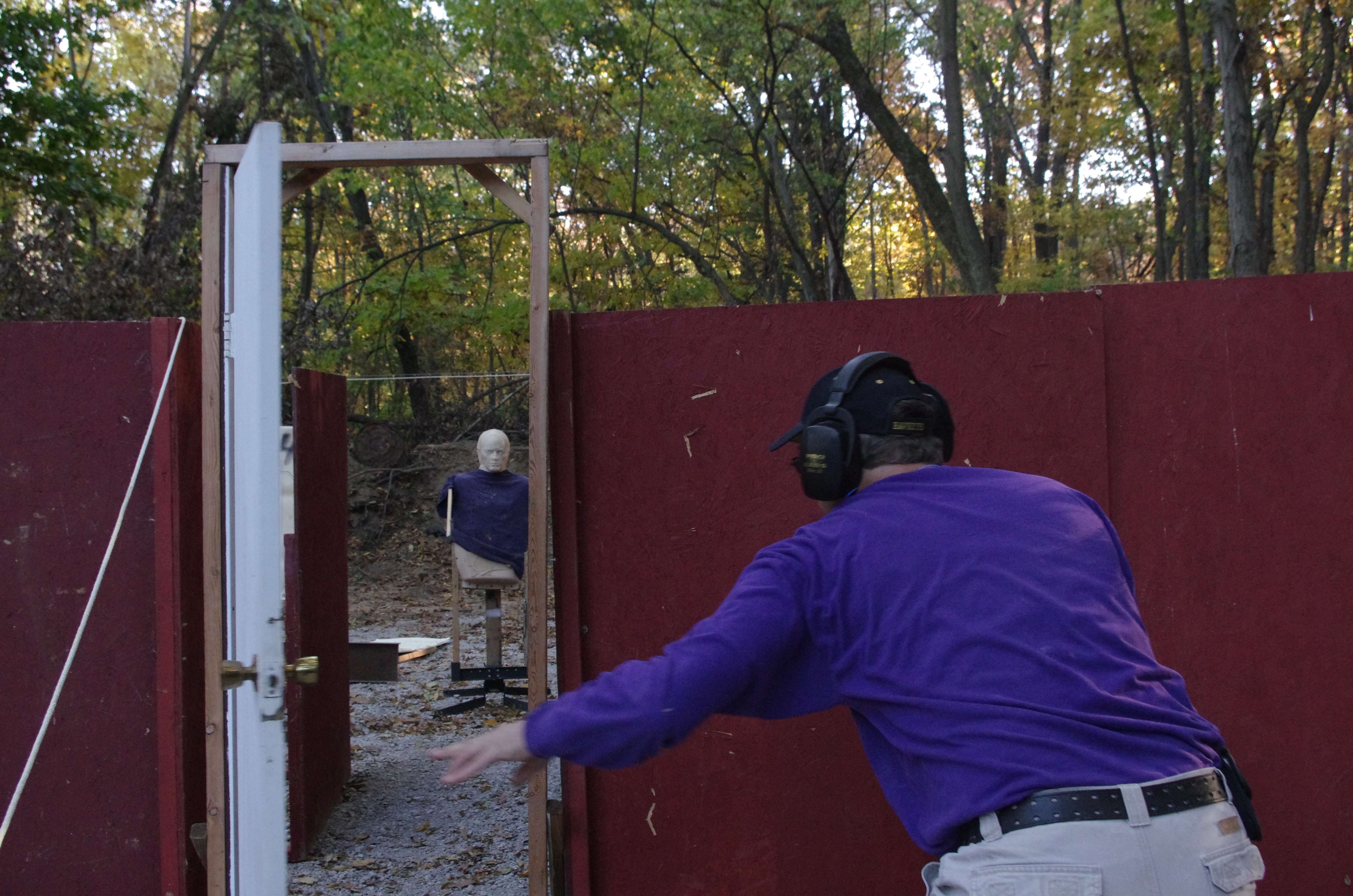
This depends somewhat on the level of training and skill level you are in. The higher your level of skill the more complex the scenarios can be. Our training can be very complex and still be safe. I don’t believe simple is the best way. We are complex beings and capable of more. With experience and exposure we are capable of making choices on the best response in milliseconds from a mental library of responses. Scenarios can be; in a public setting, home invasion, active shooter, bad guy in a crowd, shoot/no shoot situations, defending a loved one in close quarters, close quarters contact, hostage situation, car jacking, you name it as long as we are safe we can scenario train. I like to get as realistic as possible within the considerations of safety to all involved, student, instructor or others that may be in the area. Often in scenarios we set up the unknown. Unlike competition where the stage is presented and you can walk through to see the position of the targets. The threat or non-threat appears without the student having advanced knowledge of what they will be presented with. Or the student is forced t make a judgement call to choose that response after being briefed about the scenario; Shoot, don’t shoot, evade, evade and shoot, strike and shoot, among many. The addition of 3-D targets, 3-D reactionary targets 3-D Moving and charging targets along with paper adds realism to the scenario. The weapons in the scenario are realistic looking non-firing replicas, gun ,knife, stick or other.


I read once that training with firearms is;

75% physical and 25% mental

A gunfight on the other hand is:

25% physical and 75% mental

Scenario based training and the use of 3-D humanized targets and 3-D humanized reactionary targets along with paper we can bring the numbers closer together by adding realism to our training. We can go even further to bring more realism by adding into the scenarios factors like distractions, cognitive thinking skills, movement, and the addition of training replica weapons and devises to identify the bad guy or good guy. Add in unorthodox positions, concealment, obstructions, doors and manipulation, the unknown or hidden and we get even more realism in our scenarios. In unorthodox shooting positions we shoot from sitting, kneeling, on our belly, on our back, on our side, seated in a chair, or from behind cover/concealment with minimal exposure by leaning. This can still be done safely and can be done on a square range. Many ranges won’t allow movement or anything outside of standing on the firing line and shooting holes in paper or plinking steel. Some won’t allow you to move steel targets or the target stands from there set position. Possibly because of perceived liabilities and a failure to understand defensive training vs target shooting. T-M Firearms Training has the advantage of training on a privately owned range which allows us to train in realistic ways you may not get somewhere else.

Toney Blauer said in an interview:

The premise is quite simple: all training should be three dimensional, i.e., it should blend the emotional, psychological and physical arsenals; anything you work on should connect to some sort of scenario so that, irrespective of the drill, there’s an emotional and psychological rationale for the exercise. This way training triggers and creates connections between all three arsenals.

An added benefit to scenario based training and proper training is it helps you maintain the complex motor skills you will have need of in a fight. Skills like hitting the magazine release to reload, fix stoppages, clear major malfunctions, even striking, blocking, grabbing, opening a folding knife and others. Toney Blauer’s comments about blending the arsenals is on spot. Build your arsenal of empty hands techniques, edged weapons, improvised weapons, firearms in handgun, shotgun, and long gun/carbine. Form and maintain muscle memories through training and practice. Build the mind, mental preparedness and mental toughness. Strengthen yourself psychologically. Even the mind forgets over time and must be refreshed. Continue to practice and train for all of these skills are perishable over time. All of this is where scenario based training is so greatly beneficial and in my opinion a essential part.

Hey, About that trigger finger.

11 Friday Apr 2014

Posted by tmfirearmstrain in Uncategorized

≈ Leave a comment

342

I like posting pictures of the students actively going through scenarios of various types. It helps give people some idea of what we do in training at T-M Firearms Training. Scenarios like active shooter, charging attacker, hostage situation, defending and protecting a family member, close quarters contact, bad guy in a crowd, shoot/no shoot, home invasion, and others that a person may find themselves. The pictures are often action pictures that are taken while the student is shooting or beginning to engage the target or completing the follow through and getting off of the trigger and straightening the trigger finger after the shot. In the pictures it often appears that the student is on the trigger at the wrong time. Pictures don’t always tell the whole of the story or what is happening especially in action stills. I have on occasion had folks come down hard on the finger on the trigger. Sometimes getting down right rude. Screaming, “Where is the finger control?” You might say they are really quick to judge. For most folks who train on a square range with no movement or other actions this can seem an issue. After all how many do you know who actually train in a realistic manner and learn to utilize the skills they may need? Someone who trains strictly on, “Off trigger until sights are on target or at full extension” will certainly have concerns when they see these pictures. If they will note there is muzzle awareness which is another safety issue. Safety first, always. I get that.

So here is where we get into the trigger control and trigger finger discipline. They are different understand.

Trigger control is involving the act of squeezing the trigger smooth and consistent to the rear without disturbing the sight picture. The front sight should not move off of the target during the process of pressing the trigger. This means no jerking the trigger. No slapping at the trigger. No stopping and starting as the trigger is pressed. Proper placement of the finger on the trigger. Trigger control is essential for accuracy. Lack of it can be devastating to accuracy. Jerk the trigger you miss! “Trigger control, Trigger control.”

Trigger finger discipline on the other hand is keeping the finger off of the trigger until ready to shoot. This could be keeping the finger straight and on the frame or slide of the gun (best). Could be straight and placed on the trigger guard (not the best). Could be not completely straight but not yet on the trigger (most certainly not preferred or entirely safe). I do teach, “Trigger finger straight and somewhere other than the trigger.” In defensive shooting placing the finger on the trigger is dictated by the situation we find ourselves in. In a real life situation you may find the need to place the finger on the trigger but then find the bad guy running away or giving up. We don’t press the trigger and shoot at this point. No Need! We could be looking at something we are not entirely sure is safe or secure. Thus the finger might be on or remain on the trigger without pressing for the shot. The situation could be one that we have to fire during the presentation before we reach full extension and acquire sights, close quarters or charging attacker. You may find yourself going to the trigger in preparation to fire as soon as we clear the holster, muzzle oriented toward the bad guy, or anywhere along the line of the presentation. This is what you are seeing in some pictures. Should we not be training for real life situations when we own a defensive firearm or carry a gun in public? The integrity of trigger finger discipline is still intact.

Scenario based training is so important for training in defensive shooting. Part of it is trigger control for accurate effective hits and trigger finger discipline for safety and responsibility. It is training beyond the fundamentals and basics. Of course we get the fundamentals down before we move into advanced drills and scenarios. For example; Don’t go out and try to run a close quarters contact drill without first establishing good sound fundamentals and developing skills to get it done safely. Scenario based training is training for real life. Preparing for plausible situations and developing the skills that could save both your life and the life of another. Yet still being responsible and safe. As we train safety is always a big concern. Firearms are inherently dangerous and can cause serious injury or death. As a good friend of mine Rob Pincus has put it, “The benefits of what we do in training must outweigh the safety risks.” There are risks that should never be taken when training but that could be another topic. Be safe! Train hard! Train often!

Just How Simple is Self-Defense

01 Saturday Mar 2014

Posted by tmfirearmstrain in Uncategorized

≈ Leave a comment

Just How Simple is Self-Defense?

Self-defense isn’t really as simple as some would have us believe. It is not a subject that is set in black and white. Self-defense is a whole lot of gray as we have seen in recent court cases and media covered events. In order to make good sound decisions as to when to defend, when to avoid, when to just walk away, and when to intervene we need all the knowledge and experience we can gain. Study everything you can in physical skills and mental preparedness. Train as often as you can. Self-defense and carrying a gun, knife, stick, or even empty hands techniques for the purpose of defense should not be taken lightly. “Carrying a weapon isn’t for everyone.”

Over the years the advent of the in car camera, battle cams, cell phone cameras, security cameras on every wall and post, and now today’s body camera we are learning more and more about what to expect and how we react in a life threatening situation that we can’t get away from. We get a first hand look into what happens to us and what we do naturally and how a trained individual  has a better chance of survival and maintains better control over the untrained. We also get to see those incidents of poor judgement and unjustified acts. The videos are watched and studied meticulously by experts and trainers everywhere. Today we have dozens of organizations that are dedicated to studying self-defense, combat, and violence. We have a profound number of experts to give us answers and incite into the act of violence itself and what causes it and where it comes from. Experts that are dedicated to the physiological and psychological of what happens when we are faced with violence, the act of self-defense, and the aftermath of such a life changing event. These experts take the time to interview those who have survived such an incident and came out the winner. We are taking note and learning from the experiences of others that have been there. With all of this information and knowledge available to us today there is no reason not to make good use of it to arm and prepare ourselves. It’s important to our day to day safety, survival and our mental well-being.

Things have changed over the years. I have changed my mind on the way I train, what I teach, and what works most effectively and efficiently. After being with other instructors, hearing and paying attention to what the experts have to say as they break things down and my own experiences. By poring over the studies when they become available. Everything from techniques, tactics, ammunition, gear, to mental preparedness the thoughts have changed. Some of the studies of the past and the terms that came from them are now being proven flawed and outdated. That is not to say that some of the ideas are not still applicable to a certain extent. The old ideas of the K.I.S.S., Weaver vs Isosceles, O.O.D.A. Loop, Hicks Law, The Heart Rate Chart, Color Codes of Awareness, The Loss of Complex Motor Skills, and The Tueller Drill have all been looked at in new light as they apply to defense, training, and effectiveness. Some have only seen minor changes in presentation to increase effectiveness. Others have seen complete overhaul and possibly even been proven completely wrong as they were presented in the past. You still see old  ideas come up from time to time and touted as the new big idea. We still see old things taught in the old light. Look at a couple of those I listed. Some people who carry a gun have never heard of any of these terms or phrases. Many are only interested in the physical training and not driving concepts behind why we do what we do and why we move the way we do…… There is more to it than just “How To”. There is “Why” and ” When to”.

Loss of complex motor skills; Yes, we can see a deterioration in complex motor skills in a critical situation. Your level of training will have a dramatic affect as to what extent complex motor skills are lost. We can still perform and maintain very complex motor skills if we properly prepare and train.

K.I.S.S.; The idea that we only need or should learn a handful of responses to an attack because too many will overload us mentally. To many choices? The human brain can make distinction to what is and determine the best response in milliseconds. Training in many responses can make us more efficient and effective defense. One response DOES NOT fit all attacks. This is also in the Hick’s Law. A computer study from the fifties that somehow became applied to defense and response decision making.

The Heart Rate Chart; Here we are told that, at 175 beats per minute, alone, will make us freeze up and loose everything. Loss of gross motor skills, bladder and bowel control, Rational thinking and control, become submissive. Not entirely true. Things like level of training, emotions, chemicals, even prior meals and drink  added to heart rate will affect reactions. A high heart rate alone is not enough. We have seen outstanding performance in individuals who’s heart rate was quite high. Above 180 beats per minute. Many factors affect this not just heart rate. Fit the Color Code of Awareness “Black” here as well.

The Tueller Drill; In this experiment it was determined that a person with hand on weapon and aware of a possible attack would take 1 ½ second to draw and fire a weapon. It takes a 1 ½ second for an attacker to move 21 feet to engage with an edged weapon. Virtual tie. These are averages. Today we have expanded the response bubble to about 30 feet to allow time for the defender to deploy his/her weapon and fire it effectively to stop the attacker to reduce the chance that injury will result. Now consider the time it takes to deploy a weapon from concealment. So when do you prepare to draw and defend as a concealed carry holder? How far out should you be looking?

When it comes down to it, there are also a lot of myths and misconceptions when it comes to training, self-defense, violence, and dare I use the word combat. Yes, I said it because at some point combat is part of self-defense. After all it’s a fight for survival in a life or death struggle. A fight is a fight but at a certain point it can become a self-defense situation because of the change in the level of force used by one of the participants. It can become a self-defense situation when overwhelming numbers are involved. Say you start with one and then suddenly face multiples.

Is Self-Defense simple? NO! If you are in a place where personal protection is a concern. If your job duties place you in that place. If you own a firearm for defensive purposes, in home, business, or concealed carry. You, are obligated to train and have the greatest amount of knowledge and preparation as you can possibly afford. Learn where violence comes from and it’s causes. Training, information, and techniques are becoming more available and evolving all the time and there is only one way to stay up to date. Old studies are being shown in a new light because of technology and science. Start basic! Study! Learn as much as you can! Get Advanced! Build confidence in your ability to defend yourself and innocents!

Mental Imagery (Visualization) in Training

22 Sunday Dec 2013

Posted by tmfirearmstrain in Uncategorized

≈ Leave a comment

Consider adding mental imagery to your training. I and some others have known this for a long time as visualization. It’s not a new concept but it is effective. It’s been used by athletes of all kinds, utilized in the shooting sports, and in the martial arts. A resent study in the Netherlands shows that mental imagery (visualization) has positive effects on law enforcement officer’s performance in critical and high-threat situations. During the study they found that law enforcement officers performed better after practicing mental imagery prior to a training scenario than those who did not. It also showed improvements in accuracy during critical incidents when using marker rounds during simulated gunfights. This is interesting because in a real gunfights hit rates can drop to a 15-50% hit rate. This includes officers who qualification scores are at 90% and above. Part of the reason for reduced hit rates is “anxiety”. Mental imagery can have a positive affect on anxiety levels as well and can help you maintain motor skills that will diminish in a real life or death situation. Maintaining motor skills is what improves accuracy. Sight alignment, trigger control, grip, shooting position all require motor skills. Some fine, some gross.  When mental imagery (visualization) realistically depicts events as in the real world it improves your performance level on many plains.  The study used officers from up and down the age scale and all experience levels. Mental imagery works even though studies have been few they are really taking a much closer look at it. I look for more studies in the future. Mental imagery allows you to walk and work through scenarios and possible responses. In the end I think it makes responses quicker and you become more adaptive to the situation and stimulus that caused you to act. Also allowing responses to more plausible events that may occur and that may require you to act defensively.  Mental Imagery, physical training, and repetitive practice creates the neural networks (both mental and muscle memories) that will allow you to maintain mental toughness and motor skill control. So, in that mental scenario. Do you interfere? Do you need to act? Is it a good time to just be a good witness and let law enforcement catch the bad guy? How many responses? What responses have what possible affect on the attacker?

← Older posts
Newer posts →

Like us on Facebook

Like us on Facebook

Follow Blog via Email

Enter your email address to follow this blog and receive notifications of new posts by email.

Join 9,065 other subscribers

Recent Posts

  • Is it knowledge? Is it training? Are you doing both?
  • Constitutional Carry and Training Obligations
  • Security, Safety, Training and Guns
  • Tueller Drill is NOT a Rule
  • Malfunction/Stoppage Drills on Day 1

Recent Comments

Edward on Why Scenario Based Training?
tmfirearmstrain on New Training Range
tmfirearmstrain on Firearms Training Methodologie…
Douglas A Cundall on Firearms Training Methodologie…
Johne44 on New Training Range

Archives

  • October 2024
  • April 2021
  • February 2021
  • October 2018
  • July 2018
  • June 2018
  • August 2017
  • June 2017
  • April 2017
  • January 2017
  • August 2016
  • June 2016
  • March 2016
  • February 2016
  • November 2015
  • September 2015
  • June 2015
  • March 2015
  • January 2015
  • December 2014
  • September 2014
  • August 2014
  • July 2014
  • May 2014
  • April 2014
  • March 2014
  • December 2013
  • November 2013
  • October 2013

Categories

  • Uncategorized

Meta

  • Log in
  • Entries feed
  • Comments feed
  • WordPress.org

Powered by WordPress.com.


Loading Comments...